

Making Trades
Knowledge Level: Essential (core concepts and foundations)

Introduction
Personally, I favor a buy-and-hold strategy. While some investors pursue active trading, research consistently shows that frequent trading often leads to lower returns for the average investor. In contrast, buy-and-hold investing is typically a gradual, disciplined, and admittedly boring way to build wealth over time.
Even if you follow a passive investment strategy, you will need to place buy and sell orders. Every investor should understand the basic mechanics of trading, including common terminology, available order types, and when each may be appropriate. In this month’s newsletter, we’ll cover the essentials.
Understanding the details of trading should increase your confidence when buying and selling stocks, ETFs, and other securities through public exchanges such as the NYSE and Nasdaq.
Be aware that your brokerage platform may offer different features or use slightly different terminology than the examples discussed here. However, the concepts are universal and should help you understand the options available through your broker.
One last caution before getting started: Understanding how to place a trade does not replace the need to research the investment itself. Just because you know where the gas pedal is doesn’t mean you’re prepared to drive in the Indy 500.
Let’s dive in.
Market Orders
The most basic and straightforward order you can place is a market order. A buy or sell market order entered while the market is open (generally between 9:30 AM and 4:00 PM ET for U.S. markets) will be executed at the next available market price. For actively traded securities, execution usually occurs almost immediately.
If you place a market order when the market is closed, the order will wait until the next market opening before it is executed. Be aware that the final execution price may differ from the previous day’s closing price because markets continue to process news and information after regular trading hours. As a result, significant price changes can occur between one day’s close and the next day’s opening.
Mutual Funds
While Exchange Traded Funds (ETFs) also trade continuously while the market is open, mutual funds behave differently. Mutual funds are traded based on the Net Asset Value (NAV), which is calculated after the market closes.
Mutual fund orders submitted before the market closes are generally executed using that day’s NAV. Orders submitted after the market closes are typically executed using the next business day’s NAV.
Unlike stocks and ETFs, which trade throughout the day at observable market prices, mutual fund shares are priced only once per day after the market closes. Therefore, investors will not know the exact price of a mutual fund transaction when the order is placed.
A mutual fund’s NAV represents the per-share value of all assets owned by the fund after expenses and liabilities are accounted for.
NAV calculation: (Total Assets - Total Liabilities)/Total Shares Outstanding
Total Assets - The market value of all securities and other assets owned by the fund at the end of the trading day.
Total Liabilities - The expenses and obligations of the fund.
Total Shares Outstanding - The number of fund shares currently held by all the investors.
Suitability
Market orders are well-suited for long-term investors who have already determined that a particular stock, ETF, or mutual fund belongs in their portfolio. The intent is to buy or sell the security at the market price, without price or time conditions.
The focus is on the long-term role of the investment within the portfolio rather than short-term price movements. Investors using market orders are generally more concerned with achieving their desired asset allocation than negotiating a specific purchase or sale price.
Limit Orders
A limit order allows you to specify the maximum price you are willing to pay when buying a security or the minimum price you are willing to accept when selling one.
Buy
A limit order to buy a security will be executed only at your specified price or lower. If the market price never falls to your limit price, the order will remain open and unfilled.
Depending on trading activity, portions of your order may be filled at different prices and at different times. There is also no guarantee that your entire order will be completed.
For example, if XYZ company is currently trading at $12 and you place a limit order to buy 100 shares of XYZ at $10. If XYZ’s price falls to $10 or below, you may see confirmed trades such as:
Buy 35 shares of XYZ filled at $9.25
Buy 50 shares of XYZ filled at $9.15
Buy 15 shares of XYZ filled at $9.17
If XYZ’s price remains above $10, your trade will remain open until filled or until some other condition (typically established by you) is met.
Sell
A limit order to sell a security will be executed at or above the price you establish. If the market price does not rise to or above your established price, the order will not be executed and will remain open.
Again, partial orders may be filled at different prices, potentially over several days, to complete your request. There is also no guarantee that all your requested shares will be sold.
For example, if XYZ company is currently trading at $10 and you place a limit order to sell 100 shares of XYZ at $12. If XYZ’s price rises to $12 or above, you may see confirmed trades such as:
Sell 35 shares of XYZ sold at $12.25
Sell 50 shares of XYZ sold at $12.15
Sell 15 shares of XYZ sold at $12.17
If XYZ’s price remains below $12, your trade will remain open until filled or until some other condition (typically established by you) is met.
Suitability
An easy way to remember the behavior of limit orders is to think of the simple market strategy “buy low, sell high”. When you place a limit order to buy, you are saying you will not pay more than X, but are willing to pay less than X (buy low). A limit order to sell says you will not sell for less than Y, but are willing to sell for more than Y (sell high).
Limit orders may be especially useful during periods of high market volatility when prices can move significantly in a short period of time. They can help investors avoid paying more than intended when buying or accepting less than intended when selling. They allow investors to establish a specific acceptable purchase or sale price. The trade-off is that execution is not guaranteed.
Also, as noted earlier, prices fluctuate while the market is closed. A limit order placed while the market is closed can protect a buy/sell order from after-hours volatility.
Because limit orders can remain open for extended periods and may only be partially filled, investors often combine them with additional instructions that control timing and execution (see Additional Instructions below).
Unlike market orders, which prioritize execution, limit orders prioritize price.
Stop Orders
Stop orders are commonly used to manage risk, protect gains, limit losses, or trigger trades when a security reaches a specific price. Similar to limit orders, the trader establishes a price either below the market (sell stop) or above the market (buy stop). Unlike limit orders, stop orders may execute above or below the established price once triggered.
There is no guarantee a stop order will be triggered because the security may never reach the specified stop price. Once triggered, however, the stop order becomes a market order and is submitted for execution at the next available market price.
To avoid the market order execution, stop orders can be combined with limit orders (stop-limit orders) where the stop price activates the order, but the limit price determines the trade price.
Sell Stop Orders
A sell stop order, often called a stop-loss order, is designed to sell a security when its price falls to a specified level. This is the stop price and acts as a trigger to activate the sell stop order. Again, once the order is activated, it becomes a market order and will trade at the next available price, which could be above or below the stop price during periods of rapid market movement.
Suitability
A sell stop order is established to protect a gain. It is set below the current market price, so if the security price falls, it will trigger your sale.
Investors may use a sell stop order to protect unrealized gains in a rising market.
For example, a stock purchased for $50 has grown to $100, and the investor wants to realize some gains if the stock should start to fall. They could establish a sell stop order at $90. If the stock price falls to $90 or below, the stock will be sold, and the investor will realize the gains.
A sell stop order can also take the emotion out of a stock sale. The investor determines an acceptable gain and establishes the sell stop order in advance of any market movement.
Buy Stop Orders
A buy stop order is an order placed to buy a security when the equity price reaches a specific point above the current market price. This is the stop price and acts as a trigger to activate the buy stop order. Just like sell stop orders, once the order is activated, it becomes a market order and will trade at the next available price.
Suitability
A buy stop order is established to “catch a rising star” or minimize a loss when obligated to make a purchase. It is set above the current market price, triggered when a security price rises.
Buy stop orders are commonly associated with “momentum trading”. The idea is that a stock breaking above an important price level (e.g., 52-week high) may continue moving higher as additional buyers enter the market. The buy stop order sets an activation price to purchase the stock on its way up.
Because a buy stop order only activates when the stock reaches the specified price, it can help investors avoid buying a security that continues to decline rather than showing signs of upward momentum.
A more complex scenario, typically using buy stop orders, involves short sales. Short sales involve selling a security that you do not currently own (see Fun Fact below). The hope is that the price will fall before the seller is required to purchase the shares to close the short sale. Because there is no limit to how high a stock price can rise, short sellers face potentially unlimited losses. A buy stop order can help manage this risk by automatically purchasing the stock if it rises to a predetermined price, thereby closing the short position.
Stop orders can be useful risk-management tools, but investors should understand that the final execution price may differ from the stop price, especially during periods of extreme volatility or when a stock experiences a significant overnight price gap.
Additional Instructions
We’ve discussed how different order types can influence price and execution. Additional order instructions allow investors to indicate how long an order should remain active and under what conditions it should be executed.
Here is a list of the most common additional instructions:
Good ‘Til Canceled (GTC) - Keeps an order active until it is filled, canceled by the investor, or reaches the brokerage’s maximum allowable duration (often 30–180 days).
Day Order - Any portion of the order not executed by the end of the trading day is automatically canceled.
Fill or Kill (FoK) - Execute the entire order immediately at the specified price (or better) or cancel the entire order.
Immediate or Cancel - Similar to the FoK but allows for a partial fill. The remaining portion of the order is immediately canceled.
On the open - Attempts to execute the order as close as possible to the market opening. Any unfilled portion is canceled.
On the close - Attempts to execute the order as close as possible to the market close. Any unfilled portion is canceled.
All or none - Fill the entire order or none of it.
Most long-term investors primarily use market orders, limit orders, Day Orders, and Good ’Til Canceled instructions. The more specialized instructions are generally used by active traders or investors with specific execution requirements.
Advanced Order Types
A detailed discussion of advanced order types would go beyond the scope of this Essential-level newsletter. However, a few are worth mentioning for awareness and as a starting point for those interested in exploring further.
Trailing Stop-Loss Order - A stop price is set at a fixed percentage or dollar amount below the market price for a sell order (or above the market price for a buy order). The stop price automatically adjusts as the market moves in your favor but remains fixed if the market moves against you.
Contingent - An order that becomes active only when a specified condition is met, such as a percentage price change, a new 52-week high or low, or another predefined event.
One-Triggers-the-Other (OTO) - Execution of one order automatically activates a second order.
One-Cancels-the-Other (OCO) - Established for two open orders. If one is executed, the other is canceled.
One-Triggers-a-One-Cancels-the-Other (OTOCO) - A primary order activates two secondary orders. If one of the secondary orders executes, the remaining order is automatically canceled.
Short Sale - Selling borrowed shares with the intention of repurchasing them later, ideally at a lower price.
Fun Fact
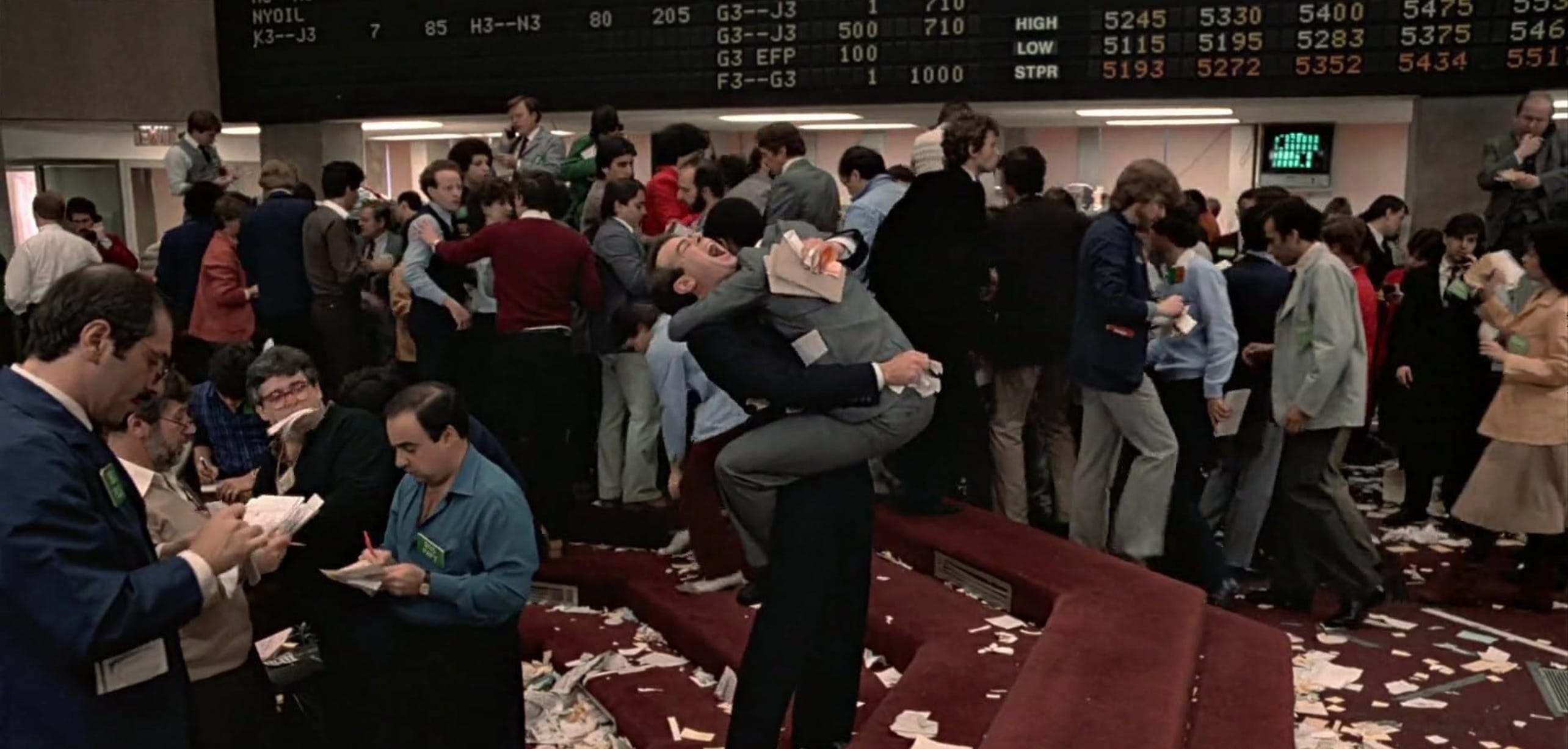
In the 1983 movie Trading Places, Billy Ray Valentine (Eddie Murphy) and Louis Winthorpe III (Dan Aykroyd) shorted Frozen Concentrated Orange Juice futures to become rich and bankrupt the Duke brothers.
Before the public announcement of the orange crop, Billy Ray and Louis obtained crop information indicating that orange juice prices would fall because the orange supply was abundant. The Duke brothers were led to believe they had insider knowledge that the orange crop was bad, resulting in scarcity and higher prices. It’s a fun Hollywood plot, but it should be pointed out that this is insider trading and illegal.
Armed with advanced knowledge that orange prices would fall, Billy Ray and Louis shorted orange juice while the Duke brothers bought it. When the price crashed (the orange crop was good), Billy Ray and Louis closed their short position at a significantly lower price, while the Duke brothers had borrowed money to make purchases at a much higher price.
One of my favorite quotes is from this movie. As Louis and Billy Ray sip champagne on a beautiful tropical beach, surrounded by their wealth and luxury, Louis: “Looking good, Billy Ray.”, Billy Ray: “Feeling good, Louis.”

Purpose Update
Here is a quick update on my encore career and purpose-filled pursuits. I spent my first year of “retirement” completing the certifications, registrations, and other requirements needed to establish Purpose Capital LLC as a Registered Investment Advisor. Since then, I have focused on refining my client experience and advisory process. This has included developing templates, secure file-sharing procedures, contract workflows, and working with an initial client to test and refine the process from start to finish.
I also developed my website. As someone who spent 35 years in information technology, I found this process particularly enjoyable because it allowed me to combine decades of engineering experience with modern AI tools. I was able to apply the engineering discipline developed throughout my IT career while leveraging AI tools to assist with the coding and implementation. The project included planning reviews, written requirements, source control, testing, and automated deployments to both test and production environments. I remember when (not all that long ago) this required a team of highly skilled professionals and months of effort. The experience reinforced my belief that technology continues to create opportunities for individuals and small businesses to accomplish things that once required much larger organizations. If you’re curious, the finished site can be found at purposecapitalllc.com.
I remain excited and optimistic for the opportunity to provide financial guidance for those who need it most.
And, of course, it’s summer. I have been working on some new wakeboard tricks, and to a lesser extent, maintaining my waterskiing skills. Also, completely against the advice of my dermatologist, my tan is coming along just fine.

Purpose & Pennies — aligning your money with what matters most.
Disclaimer: Purpose & Pennies is an educational publication produced by Purpose Capital LLC. Content is for informational purposes only and should not be considered personalized investment advice or a recommendation to buy or sell any security.